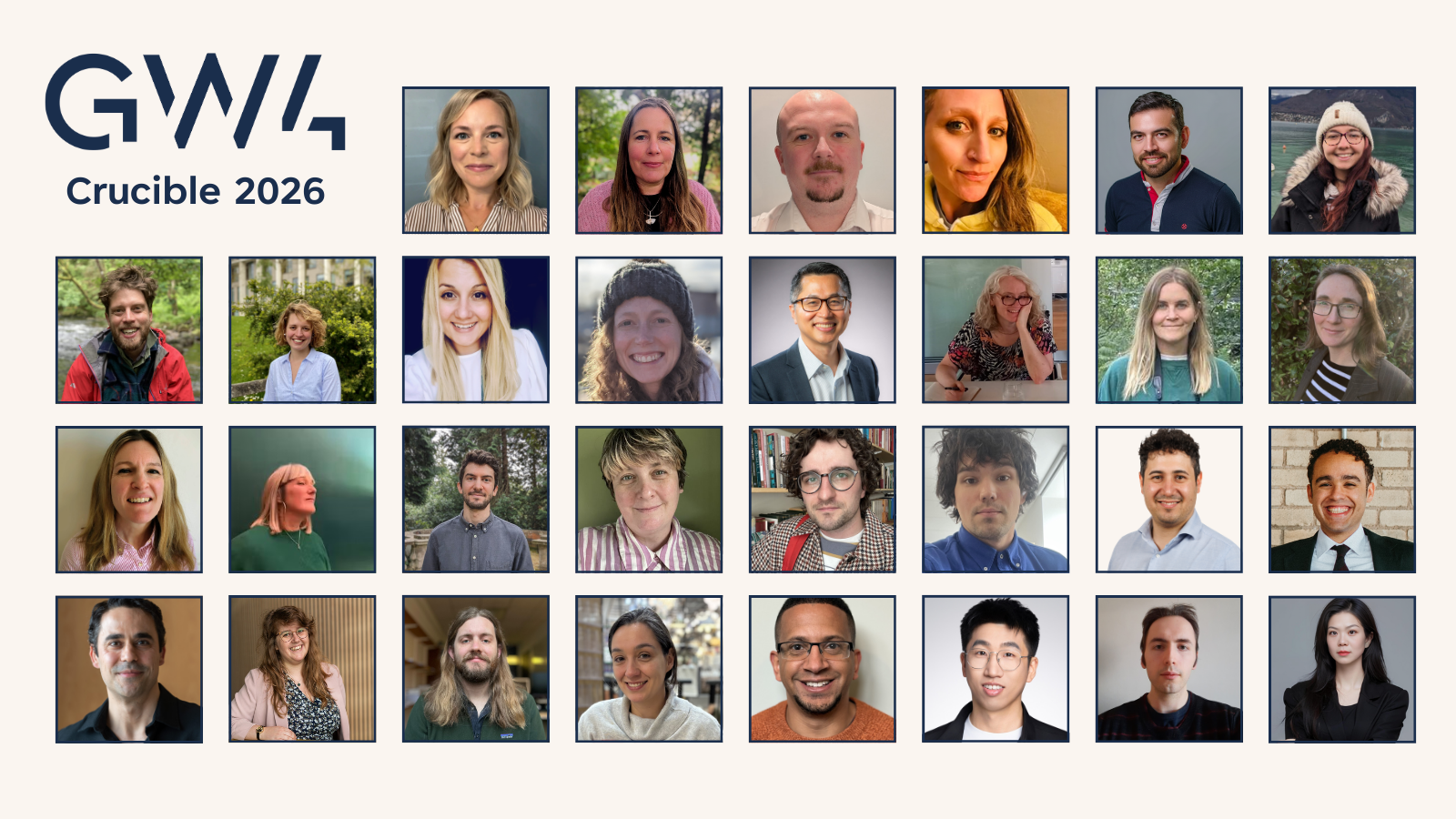
To celebrate the 10 year milestone, this year’s theme focuses on imagined futures. Participants will be encouraged to work across and at the intersection of disciplinary boundaries to explore possible future scenarios and shape positive outcomes through critical thinking, creativity, and innovative approaches.
This year’s successful researchers have a wide range of research interests and expertise including environmental science, architecture and civil engineering, international development, digital health, cultural studies, politics and modern history, molecular biology, mathematics, data science and AI, medieval literature, law, astronomy and astrophysics and quantum computing.
GW4 Crucible provides a unique opportunity for early career researchers to learn how interdisciplinary collaboration can enhance the impact of their work. Through the programme, participants develop new partnerships, gain career development support, and engage in activities designed to strengthen leadership skills. They also have the chance to apply for seed funding to launch new collaborative interdisciplinary projects that emerge during the programme.
The hybrid programme combines two in-person residential labs with four online masterclasses delivered by expert speakers. Together, these sessions support researchers as they expand their networks, broaden their perspectives, and enhance their visibility across the sector.
Dr Sabrina Fairchild, GW4 Talent and Skills Manager welcomed this year’s cohort: “It is fantastic to see the breadth and depth of expertise represented across this year’s participants. The GW4 Crucible programme has a strong track record of providing transformational experiences by bringing together early career researchers from radically different disciplines to develop new approaches to tackling societal and global challenges. It enhances the careers of our future research leaders, creates new opportunities, strengthens research culture, and develops vital collaboration and leadership skills.
“As we launch GW4 Crucible 2026 – now in its tenth year – I am delighted to see it remain highly valued by researchers. Its continued success is a testament to the innovative and adaptive design of the programme, which has evolved to meet the needs of different cohorts and the shifting research and education landscape, while always providing exciting interdisciplinary challenges that expand horizons.
“I am very much looking forward to meeting the new 2026 cohort over the coming months, hearing their innovative ideas, and seeing how both they and their interdisciplinary research projects develop as they delve into imagining new futures.”
Meet the successful researchers taking part in Crucible 2026 and follow programme updates on GW4 LinkedIn.